MAUNDY THURSDAY
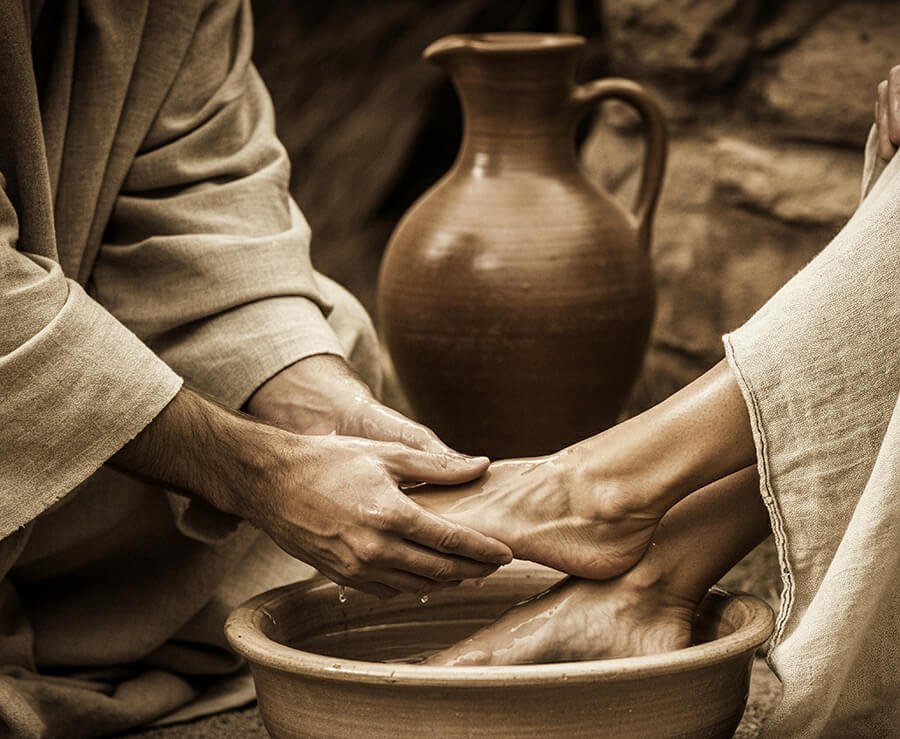
Holy Thursday is very rich in ceremonies. As well as the Tenebrae, celebrated in the early morning, there are three Masses. The first is the Pontifical Mass for the consecration of the Holy Oils, the second is an ancient Mass for the reconciliation of public penitents, and the third, which we know well, is called the Mass of the Last Supper. The word Maundy refers to this day, since it was on this day that Christ washed the feet of the apostles, and gave them a new commandment, that they would do as He had done for them. The Latin word mandatum, a commandment, is the origin of the word maundy used in English for this holy day.
There cannot be any touching celebration than the Mass of the Last Supper, which remembers the betrayal of Judas Iscariot at the same time as the wonderful institution of the Holy Eucharist: - the sadness of man’s sins and yet the joy in the love of Christ, expressed by the ringing of the bells throughout the Gloria. The contrast is that on the same day before Our Lord suffered, on which he was delivered up by Judas, he delivered up to his disciples the sacrament of His Body and Blood. Here lies the whole drama of our salvation. We betray Our Lord by our sins, and He in turn, out of love, delivers up to us His whole self. The collect of the Mass compares the punishment deserved by Judas for his betrayal and reward promised to the good thief for his confession of Faith, and asks that like the latter we might receive the grace of the resurrection. The sorrow we feel for Our Lord’s betrayal and suffering is reflected by the absence of any bell ringing for the rest of the triduum.
The Epistle recalls the institution of the Holy Eucharist, and the Gospel the washing of feet accomplished by Our Lord at the Last Supper. Although the ceremony of the washing of the feet was common in monasteries in medieval times, it was only in 1955 that it was incorporated into the Mass of the Last Supper. However, this little ceremony makes loud and clear Our Lord’s humility and charity in obliging his disciples to follow His example, as is expressed by the chants that accompany this ceremony, especially the last one – “Where there is charity and love, God is there present”. The prayer asks that just as exterior stains are washed away, so also might interior sins be cleansed from our souls.
Mindful that Our Lord was betrayed by a kiss of peace, the kiss of peace is omitted at Solemn High Masses along with the prayer for peace at the Agnus Dei and the prayer thar follows. Immediately Mass is complete the ciborium containing the Blessed Sacrament is removed from the altar and taken to an altar ofgg repose. A solemn procession is formed, and the Pange lingua, gloriosi corporis mysterium here of St. Thomas Aquinas is entoned. At the altar of repose, symbolic of the garden of Gethsemane, all kneel after a double genuflection, and there with flowers and lights Our Divine Saviour is honoured in silence by the adoration of the faithful until midnight, making reparation, and being faithful to Our Lord’s command: “Were you not able to watch one hour with me”. Meanwhile the stripping of the altar takes place, whilst Psalm 21 is sung. Although in ancient times the altar cloths were removed after Mass was over, this ceremony has acquired a new symbolism, expressed by this Psalm 21. It expresses the total abandonment of Our Lord on the cross, and His own stripping announced by Psalm 21: “They divide My garments among them, and for My vesture they cast lots”. Thus we share the desolation Our Lord bore for our sins, which desolation is symbolized by an empty church without decoration of any kind nor the Blessed Sacrament.
--- FATHER PETER SCOTT
SHARE
COMMENTS (0)