GOOD FRIDAY
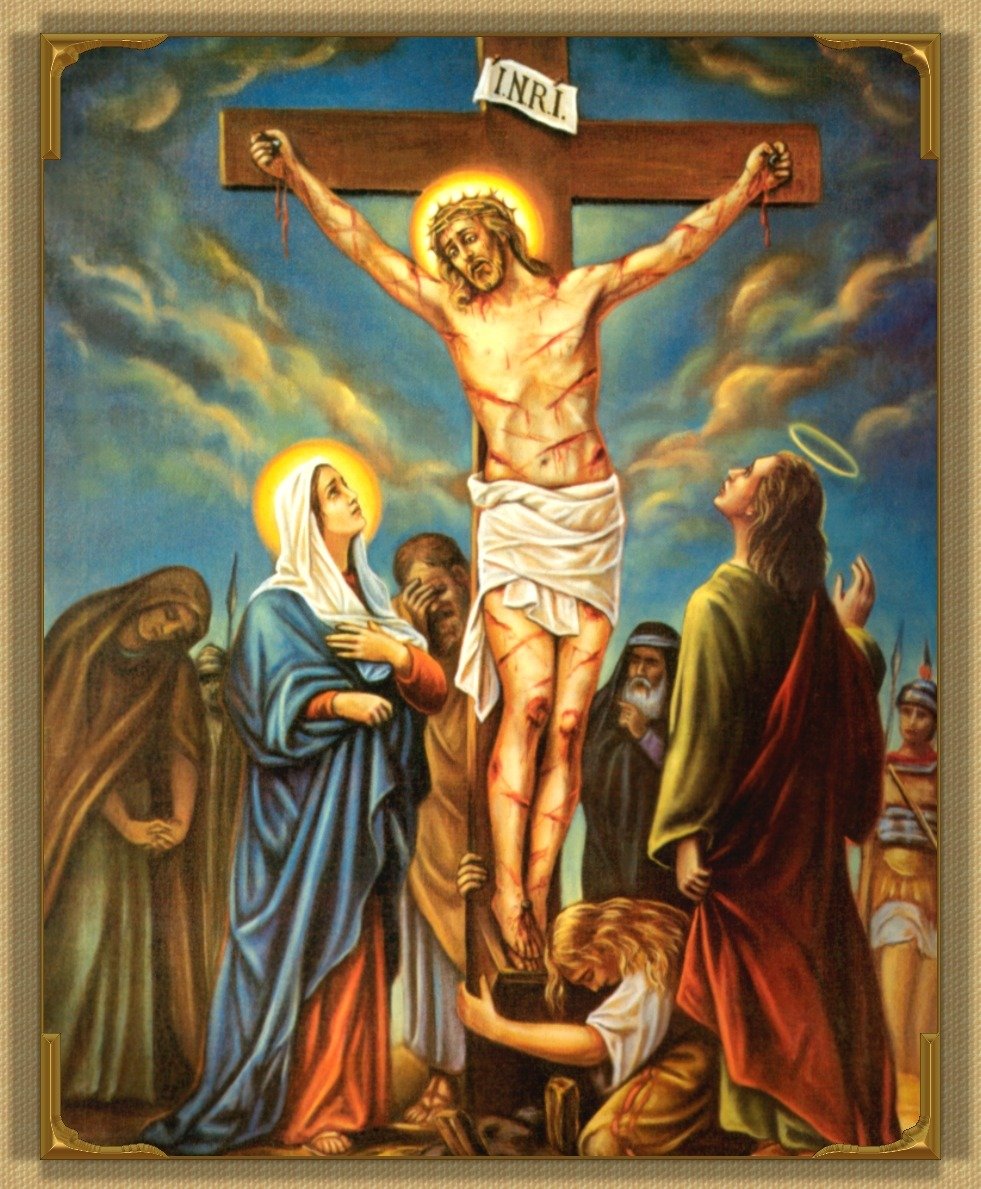
This is our day of mourning – not because Our Lord died on the cross, but because our sins were the reason for His Passion and death, and because so many souls have refused to take advantage of the rivers of grace that flow from it. It is because of this mourning that the sacrifice of the Mass is not celebrated on Good Friday.
The Way of the Cross is not a liturgical ceremony, but a devotion that all Catholics love to perform on Good Friday, as they follow him on the way to Calvary. It is followed by the Solemn Afternoon Liturgy. It begins with a prostration of adoration in profound silence, in a church empty of the Blessed Sacrament and of every adornment. Sinful man acknowledges his wretchedness before his Creator. The prayer is for Almighty God, who has released us from the hereditary death of original sin by Christ’s Passion, to make us sharers in His likeness, namely in the sanctity of heavenly grace.
There are four parts to the ceremony that follows: the readings, the solemn prayers, the adoration of the Cross and Holy Communion. The first reading is from the prophet Osee, who announced that God wants mercy and not holocausts. The second is from the book of Exodus, describing the passover lamb, whose blood protected from the avenging angel. It is a figure of the Lamb of God, whose precious Blood enables us to pass into the promised land of heaven. Follows the singing of the Passion according to St. John, who focuses on the divinity of Christ, and how Christ was condemned as the Son of God, and our true King, crowned and ruling as our King on the throne of the Cross.
The solemn prayers are all offered through Christ our Mediator with the Father, through whom we hope to receive all things. After the invitation to prayer all genuflect to express our dependence upon God’s providence. Then comes the prayer, first for Holy Mother Church, then for the Sovereign Pontiff, then for all the ranks of the clergy and the faithful, then for those who have public office in society, then for catechumens, then for the necessities of the faithful, then for heretics and schismatics to return to the bosom of the Church, then for the conversion of the Jews, and finally for the conversion of pagans. Nobody is left out of the love of Christ Crucified.
The adoration of the Cross then takes place. Note that the holy cross of Our Lord is the only creature to be adored. It is a relative adoration, entirely directed towards Christ, the Son of God, who poured forth His Blood on the cross. It is consequently adored not in itself, but for Christ, but it is truly adored all the same. Three times the priest sings: “Behold the wood of the cross upon which hung the salvation of the world” to which all respond “Come, let us adore”. All then come to kiss the crucifix, with a kiss giving their divine Redeemer their whole self. Meanwhile the choir sings the Reproaches. They are taken from the prophets Micheas, Jeremias and Isaias and elsewhere in the Old Testament, relating many of the wonderful things that God has done for his people. They nd are gentle complaints by Christ for their infidelity: “My people, my people, what have I done against you, or in what have I offended you. Answer me.” They are accompanied by the begging of mercy from Christ, out God, in Greek and in Latin: “O Holy God, O Holy Strong One, O Holy Immortal One, have mercy on us”. Then comes the praise of the faithful Cross, nost noble of all trees, with the singing of the hymn Pange lingua gloriosi lauream certaminis.
Then comes the reception of Holy Communion. The priest processes to the altar of repose to bring the Blessed Sacrament accompanied by the singing of three antiphons honouring the mystery of the Cross and begging the Saviour of the world to save us. The communion prayers are very simple, just the Pater noster and the Libera nos, but during the distribution of Holy Communion the messianic Psalm 21, that describes the Passion is sung. Three prayers follow, begging for a copious blessing of grace and eternal redemption and that Our Lord might sanctify His servants with eternal protection. Thus we are able to unite ourselves with the divine victim, whom we honoured sacrificing Himself on the cross.
FATHER PETER SCOTT
SHARE
COMMENTS (0)